Columns and Blogs

What High Efficiency Means for Traction Motors

Motor

The traction motor—often called the “heart” of an electric vehicle—plays a vital role in converting electrical energy into mechanical energy. The efficiency of this motor is one of the most influential factors in determining the overall energy efficiency of the vehicle.

In particular, a traction motor must deliver high energy efficiency while accommodating a wide range of driving conditions. The key to achieving it lies in technologies that maintain efficiency across a broad operating range.


1.What Does a “Wide Operating Range” Mean?

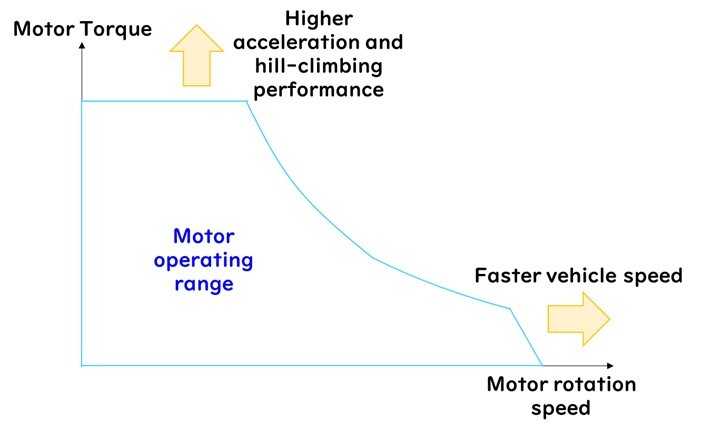
In the context of motors, the “operating range” refers to the range of rotational speeds and torque (driving force) that a motor can deliver (indicated by the blue frame in Figure 1). 

Figure 1 Motor Speed–Torque Characteristics and Operating Range

   Figure 1: Motor Speed–Torque Characteristics and Operating Range 

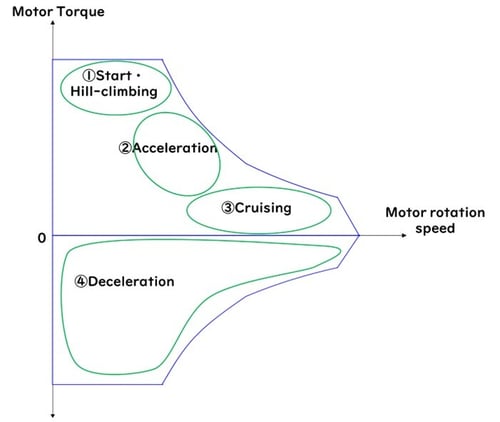
An electric vehicle experiences various driving conditions, such as starting from a stop, accelerating toward cruising speed, cruising at high speed, and decelerating (regenerative braking). A traction motor must meet specific requirements for each of these scenarios:

  1. Starting and Hill Climbing (Low Speed / High Torque):
    High torque sufficient to accelerate from zero or low speed
  2. Acceleration (Medium Speed / Medium Torque):
    Output that enables smooth transition from medium to high speeds
  3. Cruising (High Speed / Low Torque):
    High efficiency in the high‑speed, low‑torque range
  4. Deceleration (All Speeds):
    Capability to regenerate energy across the entire operating range
     

The green line in Figure 2 shows which parts of the operating range each driving condition primarily uses. From this, you can see that traction motors are required to operate efficiently across a very wide range.

Figure 2 Operating Range Used in Each Driving Condition

       Figure 2: Operating Range Used in Each Driving Condition 

Maintaining high efficiency across all these scenarios directly improves the vehicle’s energy efficiency, driving range, and environmental performance. However, because motor efficiency varies significantly depending on rotational speed and load, achieving efficiency over such a wide range requires advanced technologies.


2.Key Technologies for Maintaining Efficiency Across a Wide Operating Range 

Enhancing motor efficiency over a broad operating range involves a wide array of technologies from electromagnetic design and material selection to control systems.

1) Optimization of Electromagnetic Design

Motor efficiency largely depends on the operating point (speed and torque), so motor designers must widen the range of high‑efficiency and optimize peak‑efficiency points for typical driving conditions.

Examples: 

  • Induction motors: optimized slot shapes and winding configurations
  • Interior permanent magnet motors: rotor designs tailored to magnet characteristics

2) Motor Material Technologies

High-performance materials are essential for efficiency.

Examples:

  • Electric-magnetic steel: Using higher‑grade steel sheets helps reduce core losses.
  • Permanent magnets: Ferrite or high‑performance neodymium (Nd‑Fe‑B) magnets improve efficiency by reducing excitation losses. 

3) Advanced Inverter Control

Inverter control optimizes the electrical power supplied to the motor and has a direct impact on efficiency.

Examples:

  • Vector control, which enables efficient control from low to high speeds
  • For induction motors: control optimized for individual motor parameters such as resistance and inductance
  • For permanent magnet motors: field‑weakening control for high‑speed operation

These technologies enable high efficiency tailored to each operating point.
 

3.Motor Efficiency Maps

How can we determine whether motors maintain high efficiency over a wide range or not?
Motor specifications such as rated power are based on thermal limits at a specific operating point, so they unfortunately do not reveal actual efficiency under driving conditions.

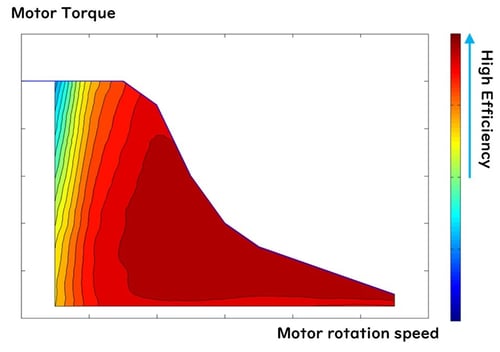
This is where motor efficiency maps come in. These maps show how efficiently a motor operates throughout its entire operating range and are essential when selecting traction motors for vehicles. 

Figure 3 Example of a Motor Efficiency Map

         Figure 3: Example of a Motor Efficiency Map

 In Figure 3, darker red areas represent higher efficiency.
By calculating the actual operating points of a vehicle—based on its designed speed, weight, tire diameter, and gear ratio—and comparing the maps with the points, engineers can select the motor that provides the highest efficiency for that vehicle system. 


4.Summary

As discussed, traction motors must deliver high efficiency across a wide operating range to meet the diverse driving conditions of electric vehicles.
However, to achieve this advantage basically requires the use of high‑grade electrical steel, permanent magnets, and other advanced materials, which inevitably increases motor cost.

In the next column, we will examine how adopting high‑efficiency motors benefits electric vehicles, and how these benefits with the associated cost increases.